Septic Inspection Before Buying a Home: What to Know
Buying a home is the biggest purchase most people ever make, and a septic system is one of the few parts of that purchase you cannot see. It is buried in the yard, it has no warning light, and a standard home inspection does not cover it. A buyer who skips a septic inspection is buying a system on faith, and the cost of being wrong is not a small repair. A failed leach field or a cracked tank can mean excavation, permits, and a bill that typically runs into the thousands of dollars, according to published guides.
A septic inspection is a separate, specialist visit. A technician opens the tank, measures the sludge and scum, checks the baffles and the filter, tests the flow, looks at the drain field, and writes a report that says, in plain terms, whether the system is sound, needs work, or is failing. For a buyer, that report is the difference between negotiating with facts and discovering a problem after the keys change hands.
This guide explains why a septic inspection matters when buying, what it covers, the EPA 14-step checklist inspectors commonly follow, the red flags that should worry a buyer, who usually pays, and what to do with the results. Waste Cleanup Services, also known as Flex Sanitation, is a family owned and operated septic company based at 934 Warwick Ave in Thousand Oaks, serving the Conejo Valley since 2023. We perform septic inspections and real estate certifications across Thousand Oaks, Newbury Park, Westlake Village, Agoura Hills, and Moorpark. Call (805) 307-3409 — our dispatch runs 24/7.
Why a septic inspection matters when buying
The first reason is simple: the system is underground and the seller may not know its condition. Many homeowners pump their tank when something goes wrong and otherwise never think about it. A seller who says the system works fine may be telling the truth as far as they know, and still be selling a house with a leach field that is slowly failing. The only way to know is to look, and a septic inspection is how you look.
The second reason is money. A septic system is one of the most expensive parts of a home to replace. Published guides put typical full system replacement in the range of about $10,000 to $30,000 or more, and a conventional drain field replacement typically in the range of about $3,600 to $12,500. Those are typical market ranges, not our prices, but they show the scale of the risk. An inspection that costs a few hundred dollars can reveal a problem worth thousands, and it gives you the chance to negotiate the price, ask for a repair, or walk away before you own the problem.
The third reason is timing. Septic problems rarely announce themselves during a showing. The drains run, the toilets flush, and the yard looks fine, because the system is only tested when it is used hard. A family moving in, with more people, more laundry, and more showers than the previous owners, is often what pushes a marginal system over the edge. An inspection tests the system the way a household will use it, not the way a vacant house uses it.
There is also the question of records. A home with a septic system should have a history: installation permits, pumping receipts, and any repair records. In the Conejo Valley, new installations and major repairs need permits from the county health department, Ventura County Environmental Health for Thousand Oaks, Newbury Park, and Moorpark, and LA County Public Health for Westlake Village and Agoura Hills. An inspection is the moment to find out whether that paperwork exists and whether the system on the ground matches it.
What the inspection covers
A septic inspection covers the whole system, not just the tank. It starts with the records: the permit history, the tank size and location, and any pumping or repair history the seller can provide. The technician then locates the tank and the leach field, opens the tank, and measures the sludge and scum layers to see how full it is and whether it has been maintained.
Inside the tank, the technician checks the inlet and outlet baffles, the parts that keep solids in the tank and out of the field, and the effluent filter, if one is fitted. A cracked or missing baffle is one of the most common findings, and it matters because a broken baffle lets solids flow straight into the leach field. The tank itself is checked for cracks, leaks, and signs of deterioration, and the lid and risers are checked for condition and access.
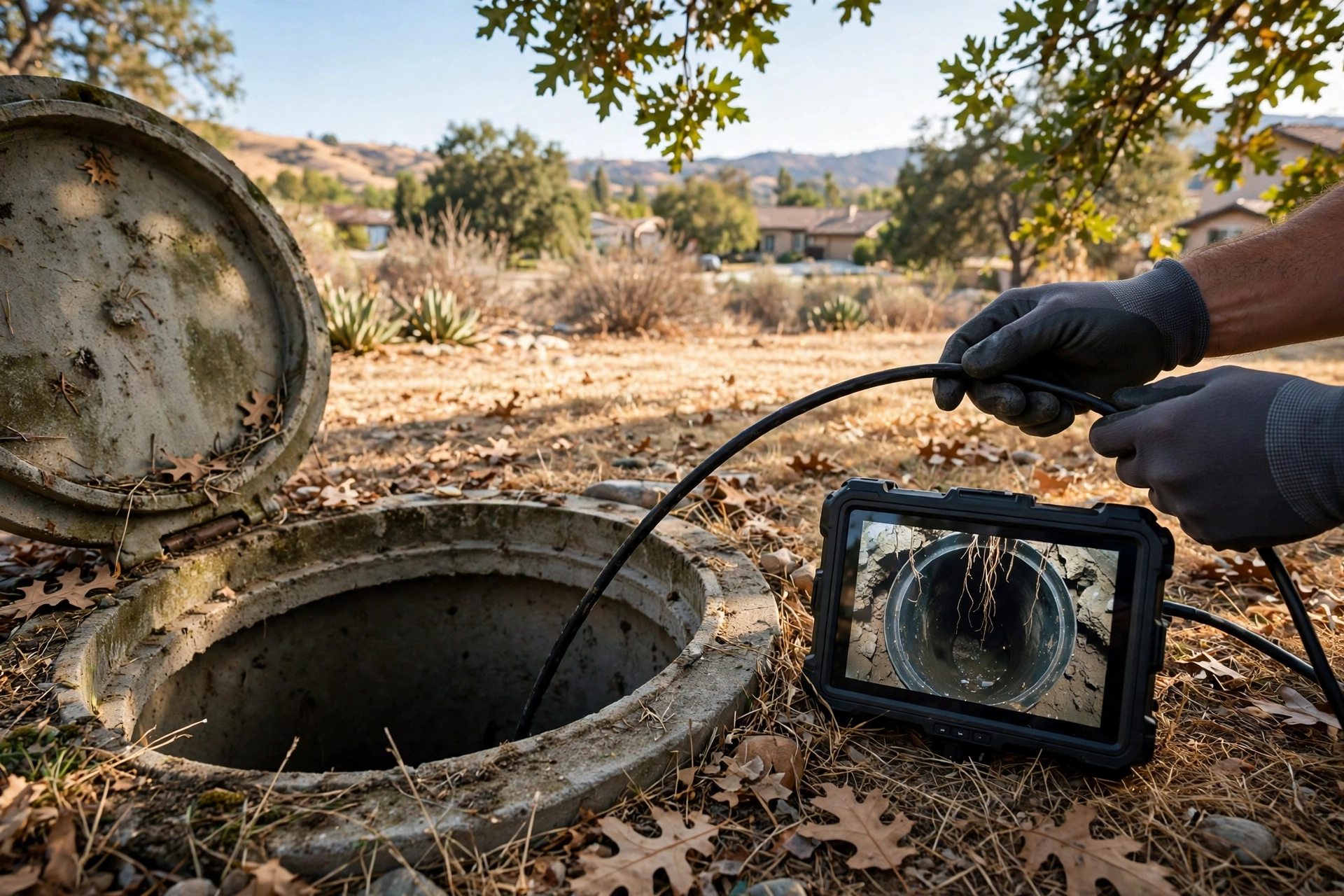
The inspection then follows the wastewater out of the tank. The distribution box, which splits the flow evenly between the field trenches, is checked for level and condition. The drain field is observed for soggy ground, surfacing effluent, odors, and unusually green grass. A flow test runs water through the system to see how it handles a real load, and a camera inspection can look inside pipes and laterals where eyes cannot reach. If the system has a pump, an alarm, or floats, those are tested too.
The result is a written report. It should list the tank size and condition, the sludge and scum measurements, the baffle and filter condition, the flow test result, the state of the drain field, and anything that needs repair, with photographs where useful. That report is the document a buyer, a seller, a lender, and an agent can all work from, and it is what turns a feeling about the system into facts.
The EPA 14-step checklist
Inspectors in the United States commonly work from a 14-step checklist described in guidance from the U.S. Environmental Protection Agency, and it is worth knowing what is on it, so you can tell whether an inspection was thorough or a quick look. The checklist is a sequence, and each step builds on the one before it. A good inspection works through all of them and records what it finds at each stage.
The steps cover the paperwork, the tank, the flow, and the field. They start before anyone opens a lid, with the records and the layout of the system, and they end with the written report. If an inspector cannot complete a step, because a lid is buried and cannot be found, or the field is under a structure, that should be written down, not skipped silently. An honest gap in the report is useful information. A missing step that nobody mentions is not.
The checklist below is the standard sequence, in plain terms. It is not a substitute for the inspection itself, but it is a useful thing to have in hand when you hire one, and a useful way to read the report when it comes back. If a step is missing from your report, ask why.
- 1. Review the system records: permits, installation details, and pumping history
- 2. Locate the tank, the distribution box, and the leach field
- 3. Check the ground over the system for settling, surfacing effluent, or odors
- 4. Open the tank and check the sludge and scum levels
- 5. Inspect the inlet and outlet baffles for damage or blockage
- 6. Check the effluent filter and clean or note its condition
- 7. Inspect the tank walls, floor, and lid for cracks or leaks
- 8. Check the liquid level and look for signs of backup
- 9. Run a flow test to see how the system handles household water use
- 10. Inspect the distribution box for level, condition, and even flow
- 11. Observe the drain field for soggy ground, odors, or surfacing wastewater
- 12. Camera-inspect pipes and laterals where access allows
- 13. Test the pump, alarm, and floats on systems that have them
- 14. Write the report: findings, measurements, photographs, and recommendations
Red flags that should worry a buyer
Some findings are maintenance items, a tank that needs pumping, a filter that needs cleaning, and they are normal parts of buying a home with a septic system. Others are red flags, and a buyer should take them seriously. The first is a cracked or leaking tank. A tank that has lost its structure cannot be patched reliably, and replacement means excavation and permits.
The second is a failing leach field. Soggy ground over the field, surfacing effluent, strong odors in the yard, or drains that back up under a normal flow test all point to a field that is no longer treating wastewater. A failed field is the most expensive single problem a septic inspection can find, and it is the one most likely to change the price of the house or end the deal.
A broken or missing baffle is a third red flag, not because the baffle itself is expensive, but because of what it has been doing. A broken baffle lets solids into the field, and a field that has been receiving solids for years may already be damaged even if it still drains today. The same logic applies to a system with no pumping history at all. A tank that has never been pumped, or has not been pumped in a decade, has been sending solids toward the field for years, and the field may be living on borrowed time.
Other red flags are about paperwork and age. A system with no permits, no records, and no one who knows where the tank is has been neglected, and neglect is a risk. A very old system, or a system that has been modified without permits, carries the same risk. Unpermitted work can also create problems with the county health department, which is the permitting authority for new installs and major repairs in both Ventura County and LA County. None of these findings automatically means you should walk away, but all of them mean you should negotiate with the facts in hand, and get a repair quote before you close.
Who pays for the inspection?
In most home sales, the buyer orders and pays for the septic inspection, as part of their due diligence. It sits alongside the home inspection, the termite inspection, and the appraisal, and it is usually paid up front, before closing. The logic is straightforward: the buyer is the one taking on the risk, so the buyer is the one who wants the facts.
That said, who pays is often negotiated, not fixed. A seller who knows the system is sound may pay for the inspection to reassure buyers and speed up the sale. A seller who has recent pumping receipts and a clean inspection report can use them as a selling point, and some do. In other deals, the cost is split, or the buyer pays and the seller agrees to cover repairs the inspection finds. What matters is that the arrangement is written into the purchase agreement, not left to a verbal understanding.
There is no statewide rule in California that forces a septic inspection at the point of sale, and the rules differ by county and by lender. Some lenders and some buyers make an inspection a condition of the sale, and an escrow certification, a written statement that the system has been inspected and is working, is often part of that. If your lender requires a certification, the inspection needs to be done by a qualified company that can issue one, and the report needs to be in the file before closing.
Whatever the arrangement, the buyer should choose the inspector, not the seller. An inspection ordered by the seller and handed to the buyer is better than no inspection, but an inspection ordered by the buyer, from a company the buyer chose, is the one the buyer can trust. Ask your agent to write the inspection into the offer as a contingency, so that a bad result gives you the right to renegotiate or walk away.
What to do with the results
A clean report is the best outcome, and it is also a useful document to keep. It tells you the tank size, the last pump date, and the condition of the system on the day you bought the house. File it with your home records, note the next pump date, and plan on the standard 3 to 5 year schedule from there. A clean report is also proof, if you sell the house one day, that the system was sound when you bought it.
A report with maintenance items, a tank that needs pumping, a filter that needs cleaning, a riser that should be installed, is a negotiation point, not a deal breaker. Ask the seller to pump the tank before closing, or ask for a credit for the cost of the work. Pumping before closing is the most common request, because it is cheap, it is verifiable, and it resets the clock on the system for the new owner.
A report with real problems, a cracked tank, a broken baffle, a failing field, needs a repair quote before you decide anything. Get the quote in writing, with the scope and the price, and take it back to the negotiating table. The seller may agree to the repair, offer a credit, or reduce the price. If the repair is a full field replacement, the numbers are large enough that walking away is a legitimate option, and a good agent will tell you so.
Whatever the result, do not ignore it. A report that says the system needs work, filed away and forgotten, becomes a problem you own, and a problem that grows. Read the report, get the quotes, negotiate from the facts, and start your ownership with a system you understand. If you need an inspection, a second opinion on a report, or a repair quote in the Conejo Valley, call Waste Cleanup Services at (805) 307-3409. Our dispatch runs 24/7, and we serve Thousand Oaks, Newbury Park, Westlake Village, Agoura Hills, and Moorpark.
Get a free estimate
Reading is a good start — a visit is better. Tell us about your system and we will price the real scope, explain what the tank needs, and give you a fixed number. Free, no obligation.
Related service: Septic Tank
Request a Free Estimate
Tell us about your septic system — we reply within one business day.