Septic Tank Pumping Cost
Our published range is $485–$780 for a standard tank from 1,000 gallons in Thousand Oaks — upfront and flat-rate, with no hidden disposal or cover fees. This guide explains what determines the price and how to get an exact number for your tank.
 Septic Tank Pumping
Septic tank pumping is one of those jobs where the price seems to vary wildly from one company to the next, and homeowners are right to be suspicious of that. One company quotes a low number over the phone, and the final bill arrives with a digging fee, a disposal fee and a hose fee added on. Another quotes high and includes everything. The number that matters is the one you actually pay, and the only way to compare quotes fairly is to know what is in them.
This page is the cost guide for Waste Cleanup Services, operating as Flex Sanitation, a family owned and operated septic company based at 934 Warwick Ave in Thousand Oaks, serving Thousand Oaks, Newbury Park, Westlake Village, Agoura Hills and Moorpark. We publish one price as our own: $485 to $780 for a standard pump-out of a tank from 1,000 gallons in Thousand Oaks. Every other figure on this page is a typical market range published by guides like Angi or This Old House, labeled as such, so you can see where our range sits against the wider market.
What follows is the full picture: our published range, the four factors that move the price, the cost by tank size, what a full pump-out includes, emergency and after-hours pricing, the costs most homeowners forget, and how to get an exact number for your own tank. If you would rather skip the reading, call (805) 307-3409 and describe your tank: the exact number takes a few questions, not a sales pitch.
Our published range
Our published range for a standard septic pump-out is $485 to $780 for a standard tank from 1,000 gallons in Thousand Oaks. That is an upfront, flat-rate range with no hidden disposal or cover fees. It covers the five-step pump-out: inspection and tank location, cover access and vacuum line setup, complete sludge and liquid removal, tank cleaning and baffle inspection, and eco-friendly disposal with certified reporting.
The range exists because not every standard tank is the same job. A tank with an accessible lid at grade, a short hose run and a normal sludge level sits at the low end. A tank with a buried lid that has to be located and dug up, a long hose run from the truck, or a heavy sludge load sits at the high end. The range is honest about that: it tells you the most and the least a standard pump-out costs before anyone visits your property.
For comparison, typical market ranges published by guides like Angi or This Old House put a routine pump-out roughly at $290 to $700 nationally, with averages around $420 to $428. Our range sits above the national market range, and that is not an accident: Thousand Oaks is a higher-cost market than the national average, and our range includes the disposal and the reporting that some low quotes leave out. When you compare prices, compare what is included, not just the headline number.
What determines the price: the four factors
Tank size is the first factor. A 1,000-gallon tank holds less waste than a 1,500-gallon tank, and a larger tank takes longer to pump and produces more waste to dispose of. The size also sets the crew and truck time, which is the largest part of the cost. Standard residential tanks run 1,000 to 1,500 gallons, and anything larger is priced by volume.
Sludge level is the second factor. A tank pumped on schedule every three to five years has a normal sludge layer and pumps out cleanly. A tank that has gone ten years without pumping has a thick, heavy sludge layer that takes longer to remove and may need extra work to clear. The neglected tank costs more to pump, and it is also the tank most likely to have damaged the field, which is a far larger bill.
Lid depth and access are the third factor. A lid at grade, visible and reachable, is a quick job. A buried lid has to be located and dug up, and that digging is real labor. A tank behind a fence, down a slope, or far from where the truck can park adds hose length and time. The fourth factor is disposal: the waste has to go to a licensed facility, and the disposal fee is part of every legitimate pump-out, whether it is listed separately or folded into the flat rate.
Cost by tank size
The table below shows typical market ranges by tank size, published by guides like Angi or This Old House, alongside our published range. The market figures are national ranges, and Thousand Oaks prices run higher than the national average. Use the table to see how tank size moves the price, and use our range as the number that actually applies to a standard pump-out in Thousand Oaks.
The pattern is simple: the bigger the tank, the higher the range. A small tank is a quick pump-out with little waste. A large tank takes longer, holds more, and costs more to dispose of. Emergency and after-hours work sits above all of these ranges, and is covered in its own section below.
| Tank size | Typical market range | Notes |
|---|---|---|
| 750 gal | $250–$550 typical market range | Small tank; typical range published by guides like Angi or This Old House |
| 1,000 gal | $325–$700 typical market range | Most common residential size; typical range published by guides like Angi or This Old House |
| 1,000+ gal, Thousand Oaks | $485–$780 — our published range | Waste Cleanup Services / Flex Sanitation, standard pump-out, Thousand Oaks |
| 1,500 gal | $450–$1,100 typical market range | Large residential tank; typical range published by guides like Angi or This Old House |
| 2,000+ gal | $600–$1,000+ typical market range | Large or commercial tank; typical range published by guides like Angi or This Old House |
Our published range is the $485–$780 row for a standard tank from 1,000 gallons in Thousand Oaks. Every other row is a typical market range published by guides like Angi or This Old House, not our price.
What a full pump-out includes
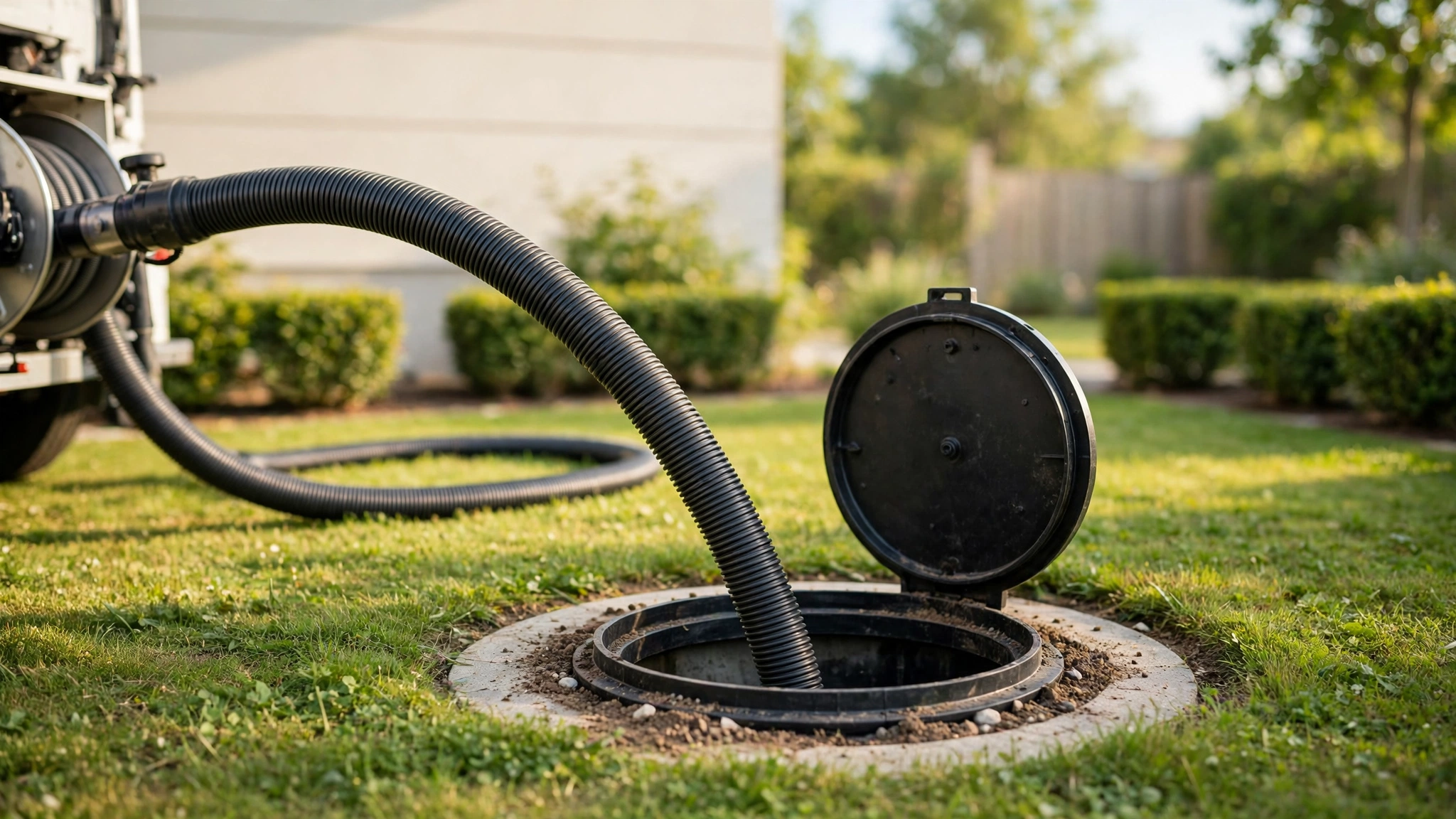
A full pump-out is not just emptying the tank. It is five steps, and each one matters. First, inspection and tank location: the technician finds the tank, checks the site, and looks at the symptoms. Second, cover access and vacuum line setup: the lid is opened and the vacuum line is run from the truck. Third, complete sludge and liquid removal: the entire contents come out, sludge from the bottom and liquid from the top, until the tank is empty. A partial pump-out that leaves sludge behind is not a pump-out.
Fourth, tank cleaning and baffle inspection: with the tank empty, the technician cleans it and inspects the inlet and outlet baffles, the effluent filter and the tank walls. This is the step that catches the broken baffle that would have destroyed the field. Fifth, eco-friendly disposal and certified reporting: the waste goes to a licensed facility, and the visit is documented. That documentation is your record for the next owner, the next inspector and the county.
When you compare quotes, ask which of these steps are included. A cheap quote that skips the baffle inspection or the disposal is not a bargain: it is a pump-out that leaves the problem in place and the waste unaccounted for. Our $485 to $780 range includes all five steps, with no hidden disposal or cover fees.
Emergency and after-hours pricing
Emergency work costs more than a scheduled pump-out, and the reasons are straightforward: a crew dispatched immediately, outside normal hours, on short notice. Our published $485 to $780 range is for a scheduled, routine pump-out. An emergency or after-hours call sits above it, because of the call-out, the timing and the urgency of stopping a backup.
Typical market ranges published by guides like Angi or This Old House put emergency septic pump-outs roughly at $600 to $1,600 or more, depending on tank size, access and the time of the call. Those are market ranges, not our prices. The exact number for an emergency visit depends on your tank, your access and when you call, and the honest way to get it is to call (805) 307-3409 and describe the situation. The dispatcher can confirm the call-out and give you a clear picture before the truck rolls.
One warning about emergency quotes: be wary of a flat emergency price given over the phone without any questions about tank size or access. The cheap phone price is usually the one that grows once the truck is on site, when lid depth, hose length and disposal get added on. A company that asks questions before quoting is a company that intends to honor the number it gives you.
Costs most homeowners forget
The pump-out is the visible cost, but it is not the only cost of owning a septic system, and the forgotten ones are the ones that surprise people. Lid location and digging is the first: if the lid is buried and nobody knows where it is, locating and digging it up is labor, and it is either in the quote or added to the bill. Risers, which raise the lid to the surface, cost money once and save money at every pump-out after that.
Repairs found during the pump-out are the second forgotten cost. A broken baffle, a cracked lid or a clogged filter is often discovered only when the tank is empty, and it has to be fixed before the system is safe to use. These are usually modest repairs, but they are not in the pump-out price. The third forgotten cost is the field: a system that has not been pumped on schedule can clog the leach field, and a field repair or replacement is a major project, with typical market ranges roughly $3,600 to $12,500 for a conventional replacement.
The fourth forgotten cost is the inspection. A real estate inspection, with a written report and sometimes a camera inspection, is a separate service from a pump-out, with typical market ranges roughly $150 to $900. The way to keep all of these costs small is the same: pump every three to five years, fix small problems when they are found, and keep the records. The $485 to $780 pump-out is the cheapest money a septic system ever costs.
How to get an exact number
An exact number takes a few questions, and any company that gives one without asking them is guessing. The questions are simple: how big is the tank, when was it last pumped, where is the lid, and how far can the truck get from it. If you know the tank size and the last pump-out date, the quote can be firm. If you do not know, the technician can find the tank and measure it on the visit.
Call (805) 307-3409 and describe the tank. The dispatcher will ask those questions and give you a number inside our published $485 to $780 range for a standard tank from 1,000 gallons in Thousand Oaks, or explain why your job sits outside it. The quote is given before the truck rolls, and the flat rate means the number you are quoted is the number you pay, with no hidden disposal or cover fees added at the end.
If you are comparing companies, ask each one the same questions: what is included in the price, is disposal included, is the baffle inspection included, and is the number flat or an estimate. Write the answers down. The company with the clearest answers is usually the company that will honor its price, and the company with the vaguest answers is usually the one whose bill grows on site.
Before you pay for a pump-out
- Ask what is included: all five steps, disposal and reporting
- Confirm whether the number is flat-rate or an estimate
- Ask about lid depth and hose length — the two most common add-ons
- Know your tank size and last pump-out date before you call
- Get the quote in writing before the truck rolls
- Keep the report — it is the record for the next owner and the county
What it costs
A standard septic pump-out in Thousand Oaks is $485–$780 for a tank from 1,000 gallons — upfront and flat-rate, with no hidden disposal or cover fees. The exact number depends on tank size, sludge level, lid depth and access.
- Pumping (standard tank, 1,000+ gal): $485–$780
- Inspection: priced by scope — see the inspection page
- Emergency / after-hours: factors on the cost guide
How a pump-out works, step by step
Every pump-out follows the same five steps — no shortcuts, no surprises. You see what we do, and you get a report that proves it.
On-site inspection & tank location
We find the tank, check the access, and look at the system before any work starts — lids, risers, baffles and the drain field.
Cover access & vacuum line setup
The tank is opened safely and the vacuum line is run from the truck. No mess in the yard, no damage to the landscaping.
Complete sludge & liquid removal
The truck removes the sludge, the scum and the liquid — the whole tank, both compartments, not just the top layer.
Tank cleaning & baffle inspection
The tank is washed down and the inlet and outlet baffles are checked. A broken baffle is the most common reason a field fails — we catch it here.
Eco-friendly disposal & certified reporting
Waste goes to a certified disposal facility, never dumped. You get a written report of what was pumped and the condition of the tank.
Tell us about your septic system
A few details is all it takes — what is happening, where you are, and anything you already know. We reply within one business day with next steps and a free estimate.
Prefer to read first? The cost guide breaks down every price factor, and the inspection page explains what a report covers.
Request a Free Estimate
Tell us about your septic system — we reply within one business day.