Septic Tank Installation
A new septic system is a thirty-year decision, and it starts with the soil under your lot. We design, permit and install septic systems across Thousand Oaks and the Conejo Valley — call (805) 307-3409 to start with a site evaluation.
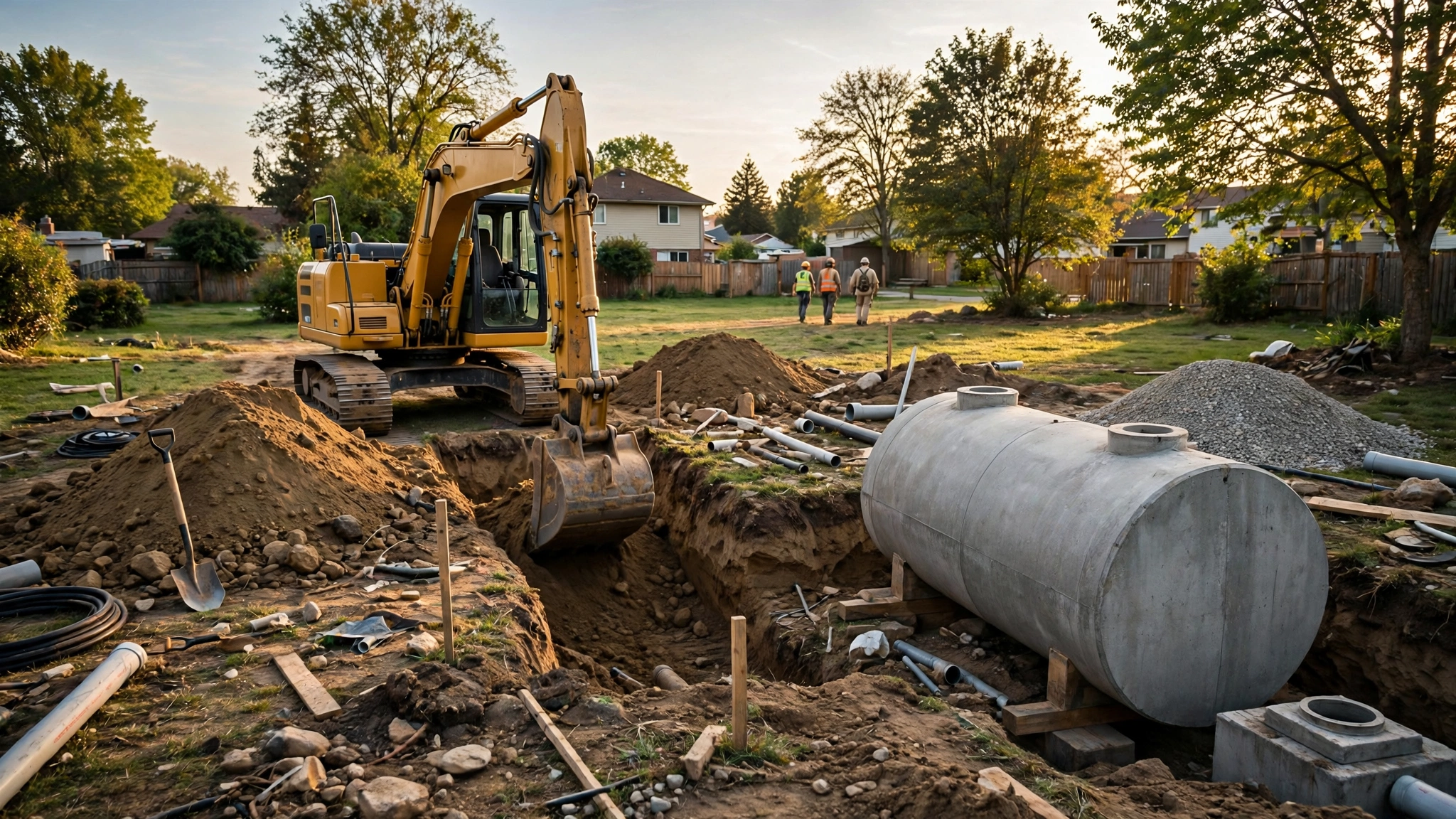 Septic Tank
Most homes in Thousand Oaks and the Conejo Valley are on municipal sewer, but a real share of properties are not: hillside lots, larger parcels, and homes built before sewer lines reached their street still rely on a septic system. When a system fails beyond repair, when a property is being built where no sewer exists, or when an old cesspool has to be replaced, a new septic installation is the project that makes the property livable.
A septic installation is not a one-day job and not a commodity purchase. It is a small civil engineering project: the soil has to be tested, the system has to be designed for the soil and the house, the county has to approve the design, and the work has to be inspected before it is buried. Done in the right order, it produces a system that works quietly for decades. Done out of order, it produces a very expensive hole in the ground.
Waste Cleanup Services, operating as Flex Sanitation, is a family owned and operated septic company based at 934 Warwick Ave in Thousand Oaks, serving Thousand Oaks, Newbury Park, Westlake Village, Agoura Hills and Moorpark. We are licensed, bonded and fully insured. This page explains how to tell whether a new system is what you need, how the installation works step by step, what permits are involved in Ventura County and Los Angeles County, what it costs, and how long it takes.
Is a new septic system right for your property?
The first question is whether you actually need a new system, or whether a repair would do. A tank with a broken baffle, a cracked lid or a failed pump is a repair, not a replacement. A leach field that has clogged but still has usable soil can sometimes be restored or extended. A new system is the answer when the field has failed completely, when the tank is structurally unsound, when the property has no system at all, or when an old cesspool has to come out.
The second question is whether the lot can support a septic system at all. That depends on the soil, the slope, the depth to groundwater, and the setbacks from wells, property lines and structures. Some lots pass easily. Some need an alternative system with a different kind of treatment. A few cannot support a conventional system and need an engineered design. The site evaluation and the percolation test answer these questions with measurements, not guesses.
The third question is whether sewer is an option instead. In some parts of the Conejo Valley, a sewer main runs close enough to connect. A sewer connection is usually the simpler long-term answer where it exists, but it is not always available, and it is not always cheaper once connection fees and street work are counted. Your installer should be honest about this: a company that only sells septic will always recommend septic, and a homeowner deserves a straight comparison before committing to either.
Choosing the right system: conventional vs. alternative
A conventional system is the one most people picture: a septic tank, a distribution box, and a leach field of trenches filled with gravel and perforated pipe. Wastewater flows from the house into the tank, where solids settle and grease floats. The liquid flows out to the trenches, filters down through the gravel and the soil, and the soil treats it. Conventional systems are simple, have no moving parts in the field, and last a long time when the soil is right and the tank is pumped on schedule.
An alternative system adds a treatment step between the tank and the field. That can be an aerobic treatment unit that uses air and bacteria to clean the wastewater, a sand filter, a mound system that raises the field above shallow groundwater, or a drip dispersal system. Alternative systems exist for lots where the soil is too slow, too fast, too shallow or too wet for a conventional field. They cost more to install and need regular maintenance, including inspections and service visits, but they make buildable lots out of ground that a conventional system could never use.
The choice is not a matter of taste. It is decided by the percolation test, the soil profile, the groundwater depth and the county rules. A good installer explains the options with the test results in hand and shows why one design fits your lot and the other does not. Be cautious of any quote that names a system type before the soil has been tested: the soil decides, and a quote written before the perc test is a guess dressed up as a plan.
The installation process, step by step
It starts with a site visit. The installer walks the lot, looks at the house plans or the existing system, checks where the tank and field could go, and notes slopes, trees, driveways, wells and property lines. This visit decides whether the project is feasible at all and what kind of system the lot is likely to need. It also produces the first honest conversation about cost and timeline.
Next comes the soil work. Test pits are dug so the soil layers can be seen and described, and a percolation test measures how fast water moves through the soil. The perc test is the single most important measurement in the whole project: it sizes the field, and if the soil fails it, the design has to change. The results go to the designer, who draws the system: tank size based on the number of bedrooms, field size based on the perc rate, and the layout based on the setbacks.
Then the permit application goes in, the trench is excavated, the tank is set, the field is built, and the county inspects the open work before anything is backfilled. Only after the inspection passes is the system covered, the site graded, and the final inspection signed off. Skipping the inspection step is not an option: an uninspected system can be ordered dug up, and no buyer, lender or insurer will accept a system with no permit record.
- Site visit: walk the lot, check access, slopes, wells and setbacks
- Soil evaluation and percolation test: measure how the ground absorbs water
- System design: tank size by bedrooms, field size by perc rate
- Permit application to the county health department
- Excavation, tank setting and field construction
- County inspection of the open system, then backfill and final sign-off
Permits in Ventura County and LA County
Permits are where the Conejo Valley gets complicated, because the valley straddles two counties. Thousand Oaks, Newbury Park and Moorpark are in Ventura County, and septic permits there go through Ventura County Environmental Health. Westlake Village and Agoura Hills are in Los Angeles County, and permits there go through LA County Public Health. The rules, the forms and the review times are different on each side of the line, and your installer needs to know which county your address sits in before anything is filed.
A permit is required for a new septic installation and for major repairs, expansions or replacements. Routine pumping needs no permit in Ventura County, and that distinction matters: pumping is maintenance, while digging a new field is construction. The permit application includes the site evaluation, the percolation test results, the system design and the site plan showing setbacks. The county reviews the design, may ask for changes, and then issues the permit to build.
The county also inspects the work while it is open, before backfill. The inspector checks the tank setting, the field construction, the pipe grades and the setbacks against the approved design. Only after that inspection passes can the system be covered. Keep the permit and the final inspection record: they are part of the property's history, and a buyer, a lender or an inspector will ask for them when the home is sold.
What a new septic system costs
A new septic system is a five-figure project, and the range is wide because the ground decides so much of it. Published market ranges from guides like Angi or This Old House put a typical new conventional system roughly in the $12,000 to $25,000 range, with full replacements running roughly $10,000 to $30,000 or more when the field, the tank and the design work are all counted. Alternative systems cost more, with typical market ranges roughly $10,000 to $20,000 for the field work alone on top of the tank and design. Those are market ranges, not our prices: the only price we publish as our own is the $485 to $780 range for a standard pump-out.
What moves the number is mostly underground. A lot with good soil and easy access is at the low end. A lot that needs an alternative system, a pump, a mound or a long excavation is at the high end. Tank size matters too: a larger house needs a larger tank and a larger field. Access matters: a lot where a truck and an excavator can reach the site easily costs less to build than a hillside lot where everything has to be carried in. Design and permit fees are part of the total as well, and they are not trivial.
Get the quote in writing, itemized, after the soil test. A quote written before the perc test cannot be firm, because the perc test can change the design. The written quote should list the tank, the field, the excavation, the design, the permit fees and the inspections separately, so you can see what you are paying for. And be wary of a price far below the market range: the usual way a cheap installation is delivered is with a smaller field, shallow cover or skipped inspection, and all three show up later as a failed system.
Timeline: from first visit to final inspection
The build itself is fast. Once the permit is in hand, excavation, tank setting and field construction usually take a matter of days to a couple of weeks, depending on the size of the system and the weather. A conventional system on a straightforward lot can be in the ground in under a week of digging. An alternative system with a treatment unit or a mound takes longer, but the construction phase is still measured in weeks, not months.
The permit is what takes the time. The site evaluation and perc test, the design, the county review and any corrections usually add several weeks before construction can start, and a design that needs revision can add more. Rain can pause excavation, and the county inspection has to be scheduled while the system is still open, which adds a few days of coordination. A realistic total, from the first visit to the final sign-off, is typically one to three months.
You can shorten the timeline by deciding quickly on the design, by having the house plans and any existing system records ready for the first visit, and by responding fast when the county asks for a correction. What you cannot shorten is the soil test or the county review: both exist to catch problems before they are buried, and rushing them is how bad systems get built.
What can go wrong — and how to avoid it
The most common failure is a field that is too small for the house or the soil. It works for a year or two, then starts surfacing effluent, because the soil was never given the area it needed. The prevention is the perc test and a design that sizes the field from the test results, not from a rule of thumb. If a quote sizes the field without a perc test, that is a red flag.
The second common failure is bad installation: pipes laid without proper grade, trenches backfilled with the wrong material, a tank set unlevel, or a distribution box that sends all the water to one trench. The prevention is the county inspection while the system is open, and an installer who welcomes that inspection instead of rushing to backfill before it happens. Ask who will be on site during the inspection, and make sure the answer is the installer, not nobody.
The third failure is a system built for the wrong house: a tank sized for three bedrooms serving a five-bedroom home, or a field designed before an addition was built. The prevention is honesty about the house as it is and as it will be. If you plan to add bedrooms, say so before the design is drawn, because a system that is undersized on day one will fail early and cost far more to fix than the larger tank would have cost at the start.
After installation: maintenance that protects your investment
A new septic system is not a fit-and-forget appliance. The single most important habit is pumping the tank every three to five years. A standard residential tank of 1,000 to 1,500 gallons fills with sludge over time, and if it is not pumped, solids pass into the field and clog it. A field that clogs in year five because the tank was never pumped is a failure that a $485 to $780 pump-out would have prevented.
Protect the field the same way you would protect any buried infrastructure. Do not drive or park over it, do not build on it, and do not send roof runoff or drainage water into it. Fix leaking toilets and faucets, because a steady leak can flood a field over weeks. Spread laundry through the week instead of running every load on one day. Keep records of every pump-out, inspection and repair, and keep the permit and the design drawings with the house records.
Alternative systems need more attention than conventional ones: scheduled service visits, filter changes and alarm checks, as the manufacturer and the county require. If your system has a pump, an aerator or an alarm, learn what the alarm means and who to call when it sounds. A new system that is pumped on schedule, kept dry and serviced as designed should give decades of quiet service, and the maintenance that gets it there costs far less than a replacement.
Before you install a new septic system
- Confirm the lot can support a system: site visit and soil evaluation first
- Get a percolation test before anyone quotes a system type or a price
- Check which county your address is in: Ventura or LA County
- Get the design, permit fees and inspections itemized in writing
- Plan the build around the county inspection — nothing gets buried first
- Keep the permit, design drawings and final inspection with the house records
What it costs
A standard septic pump-out in Thousand Oaks is $485–$780 for a tank from 1,000 gallons — upfront and flat-rate, with no hidden disposal or cover fees. The exact number depends on tank size, sludge level, lid depth and access.
- Pumping (standard tank, 1,000+ gal): $485–$780
- Inspection: priced by scope — see the inspection page
- Emergency / after-hours: factors on the cost guide
How a pump-out works, step by step
Every pump-out follows the same five steps — no shortcuts, no surprises. You see what we do, and you get a report that proves it.
On-site inspection & tank location
We find the tank, check the access, and look at the system before any work starts — lids, risers, baffles and the drain field.
Cover access & vacuum line setup
The tank is opened safely and the vacuum line is run from the truck. No mess in the yard, no damage to the landscaping.
Complete sludge & liquid removal
The truck removes the sludge, the scum and the liquid — the whole tank, both compartments, not just the top layer.
Tank cleaning & baffle inspection
The tank is washed down and the inlet and outlet baffles are checked. A broken baffle is the most common reason a field fails — we catch it here.
Eco-friendly disposal & certified reporting
Waste goes to a certified disposal facility, never dumped. You get a written report of what was pumped and the condition of the tank.
Tell us about your septic system
A few details is all it takes — what is happening, where you are, and anything you already know. We reply within one business day with next steps and a free estimate.
Prefer to read first? The cost guide breaks down every price factor, and the inspection page explains what a report covers.
Request a Free Estimate
Tell us about your septic system — we reply within one business day.