Septic Tank Repair
Slow drains, sewage smells or a soggy yard do not always mean a new system. Most septic problems are a single failed part — and a repair costs far less than a replacement. Call (805) 307-3409 for a diagnosis.
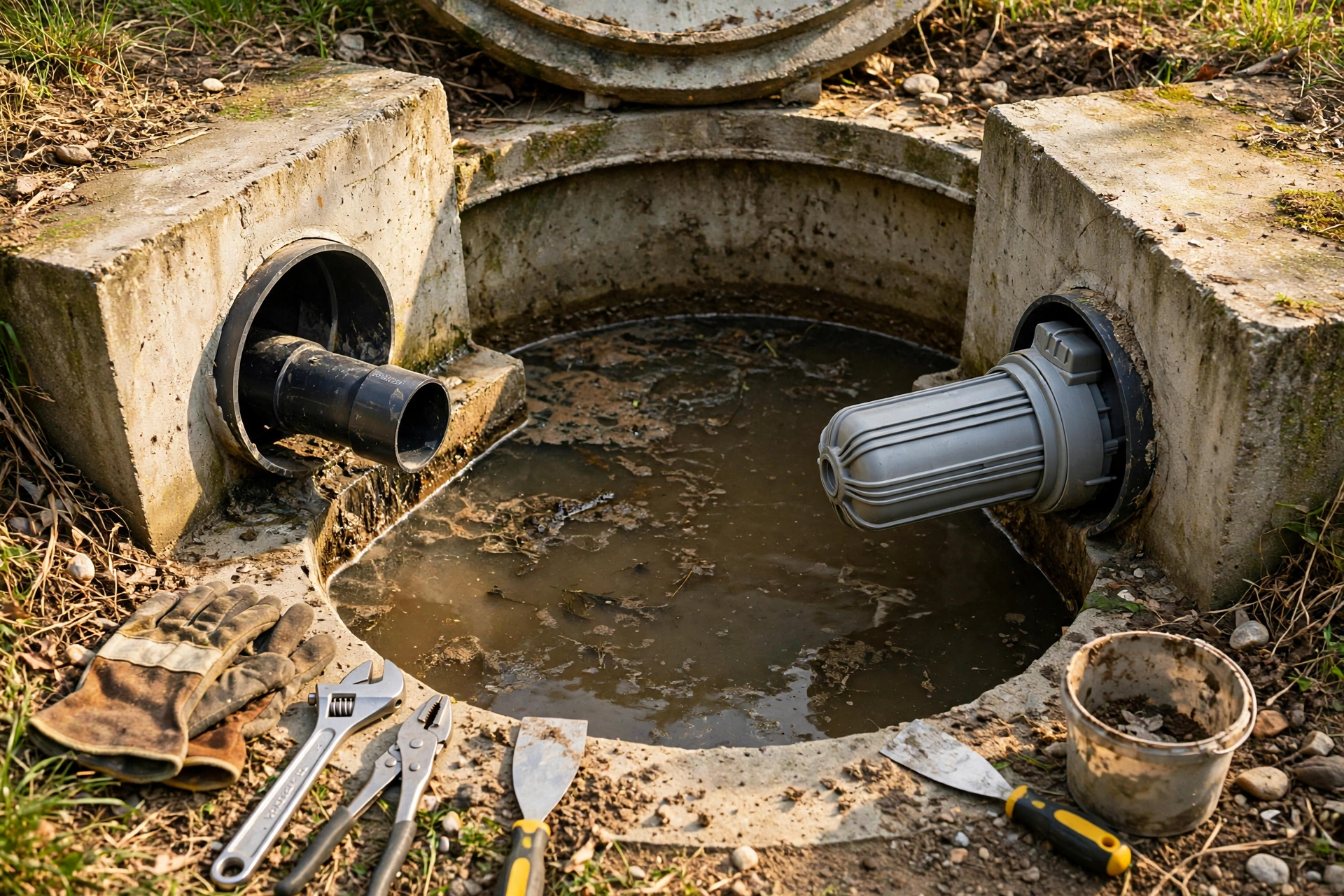 Septic Tank
A septic system is mostly simple parts doing a simple job, and when it goes wrong, the cause is usually one of them: a baffle that has broken off, a riser that has cracked, a filter that has clogged, a pipe that has collapsed, or a distribution box that has settled out of level. None of these is a catastrophe on its own. All of them get worse the longer they are ignored, because a small failure in the tank becomes a large failure in the field.
The most expensive mistake in septic repair is guessing. Pumping a tank that has a broken baffle will empty it for a few weeks, and then the backup returns, because solids are still flowing into the field. Replacing a field when the real problem was a clogged filter wastes thousands of dollars. A proper repair starts with a diagnosis: open the tank, measure the sludge, look at the baffles, check the filter, and test the flow before anyone names a price.
Waste Cleanup Services, operating as Flex Sanitation, is a family owned and operated septic company based at 934 Warwick Ave in Thousand Oaks, serving Thousand Oaks, Newbury Park, Westlake Village, Agoura Hills and Moorpark. We are licensed, bonded and fully insured. This page covers the signs that your tank needs repair, how a problem is diagnosed, the common repairs and what they involve, and how to decide between repair and replacement.
Signs your septic tank needs repair
The clearest sign is a pattern that pumping does not fix. If the drains slow down again within weeks of a pump-out, or the backup returns, the problem is not a full tank. It is a part that has failed, and the tank will keep filling with the same fault until that part is fixed. The same applies to a sewage smell that lingers after pumping, or a patch of lawn over the field that stays wet long after rain.
Other signs point to specific parts. A gurgling toilet when another fixture drains suggests a vent or a line problem. Water pooling around the tank lid suggests a cracked riser or a damaged cover. An alarm that keeps sounding on a system with a pump points to the pump, the floats or the electrical supply. Any of these is worth a call, and all of them are cheaper to fix early than after the field has been damaged.
Diagnosing the problem
Diagnosis starts with the tank open and the levels measured. The technician checks the sludge and scum layers, looks at the inlet and outlet baffles, inspects the effluent filter, and checks the tank walls and lid for cracks. That alone identifies most tank problems. A baffle that has fallen off is visible. A filter packed with solids is visible. A cracked lid is visible.
If the tank looks sound, the diagnosis moves outward: a camera inspection of the lines, a flow test to see how the field accepts water, and a check of the distribution box level. The point is to find the one thing that is actually broken, instead of replacing parts at random. A written diagnosis with what was found and what it will take to fix it is the basis for every repair we quote.
Common repairs and what they involve
Baffles are the most common repair. The inlet and outlet baffles keep solids in the tank and out of the field, and when one breaks off, solids flow straight into the field. Replacing a baffle is a tank-level job: the tank is pumped, the old baffle is removed, and a new one is fitted. It is quick, and it protects the field from the damage that an open outlet causes.
Risers and lids come next. A cracked riser lets surface water into the tank and lets sewage out, and a damaged lid is a safety hazard. Both are replaced from the surface once the tank is located. Effluent filters are cleaned or replaced on a routine visit. Distribution boxes are re-leveled so each field trench gets its share of water. Collapsed or root-invaded pipes are excavated and replaced in sections, and a failed pump, float or alarm on an alternative system is swapped for a new unit and tested.
Repair or replace: how to decide
Repair when the failure is a part and the rest of the system is sound. A broken baffle in a solid tank with a healthy field is a repair. A cracked lid, a clogged filter or a settled distribution box is a repair. The test is simple: fix the part, and the system works again for years. If the tank walls are sound and the field still absorbs water, replacement would be money thrown away.
Replace when the failure is the system itself. A tank with cracked walls that leak, a field that no longer absorbs water no matter what is repaired, or a system that is undersized for the house will not be fixed by replacing parts. Age matters too: a system that has had one failure after another is telling you its service life is over. When replacement is the honest answer, we say so, and the installation page explains what comes next.
What septic tank repair costs
Repair costs depend on which part failed and how deep it is buried. A filter cleaning or a baffle replacement is a modest job. Excavating and replacing a section of pipe costs more, because of the digging. A distribution box replacement or a pump replacement sits higher again. Published guides like Angi or This Old House describe typical market ranges for common repairs, but the honest number for your job can only come after the diagnosis, because two repairs with the same symptom can involve very different work.
What we can say plainly is what we publish: a standard pump-out is $485 to $780 for a tank from 1,000 gallons in Thousand Oaks, and that pump-out is usually the first step of a repair visit, because the tank has to be empty before most parts can be reached. The repair itself is quoted in writing after the diagnosis, with the part, the labor and any excavation listed separately, so you can see exactly what you are paying for.
How long repairs take
Most repairs are done in a single visit once the diagnosis is complete. A baffle, a filter, a riser or a lid is typically a same-day job. A distribution box or a pump replacement usually takes a day. Pipe replacement takes longer when excavation is involved, and it depends on how much line has to be exposed and how deep it runs. Major repairs that need a county permit take longer still, because the permit has to be issued before the work starts and the county inspects the finished work.
The part that takes the longest is often the scheduling, not the work. If the system is backing up, the emergency pump-out comes first to stop the damage, and the repair is scheduled right after. If the problem is found during a routine pump-out, the repair can often be done on the same visit or within a few days. Either way, the sequence is the same: diagnose, quote in writing, repair, and test the system before we leave.
Before you book a septic repair
- Note the symptoms: which fixtures, when it started, what pumping did
- Check whether the problem returns quickly after a pump-out
- Ask for a diagnosis with the tank open before any repair is quoted
- Get the repair quoted in writing: part, labor and excavation listed
- Ask whether a county permit is needed for the work
- After the repair, book the next routine pump so the field stays protected
What it costs
A standard septic pump-out in Thousand Oaks is $485–$780 for a tank from 1,000 gallons — upfront and flat-rate, with no hidden disposal or cover fees. The exact number depends on tank size, sludge level, lid depth and access.
- Pumping (standard tank, 1,000+ gal): $485–$780
- Inspection: priced by scope — see the inspection page
- Emergency / after-hours: factors on the cost guide
How a pump-out works, step by step
Every pump-out follows the same five steps — no shortcuts, no surprises. You see what we do, and you get a report that proves it.
On-site inspection & tank location
We find the tank, check the access, and look at the system before any work starts — lids, risers, baffles and the drain field.
Cover access & vacuum line setup
The tank is opened safely and the vacuum line is run from the truck. No mess in the yard, no damage to the landscaping.
Complete sludge & liquid removal
The truck removes the sludge, the scum and the liquid — the whole tank, both compartments, not just the top layer.
Tank cleaning & baffle inspection
The tank is washed down and the inlet and outlet baffles are checked. A broken baffle is the most common reason a field fails — we catch it here.
Eco-friendly disposal & certified reporting
Waste goes to a certified disposal facility, never dumped. You get a written report of what was pumped and the condition of the tank.
Tell us about your septic system
A few details is all it takes — what is happening, where you are, and anything you already know. We reply within one business day with next steps and a free estimate.
Prefer to read first? The cost guide breaks down every price factor, and the inspection page explains what a report covers.
Request a Free Estimate
Tell us about your septic system — we reply within one business day.