Commercial Septic Pumping
A business cannot close for a septic pump-out — and it cannot afford a backup during service. We pump commercial systems on schedule, after hours when needed, with certified reporting. Call (805) 307-3409.
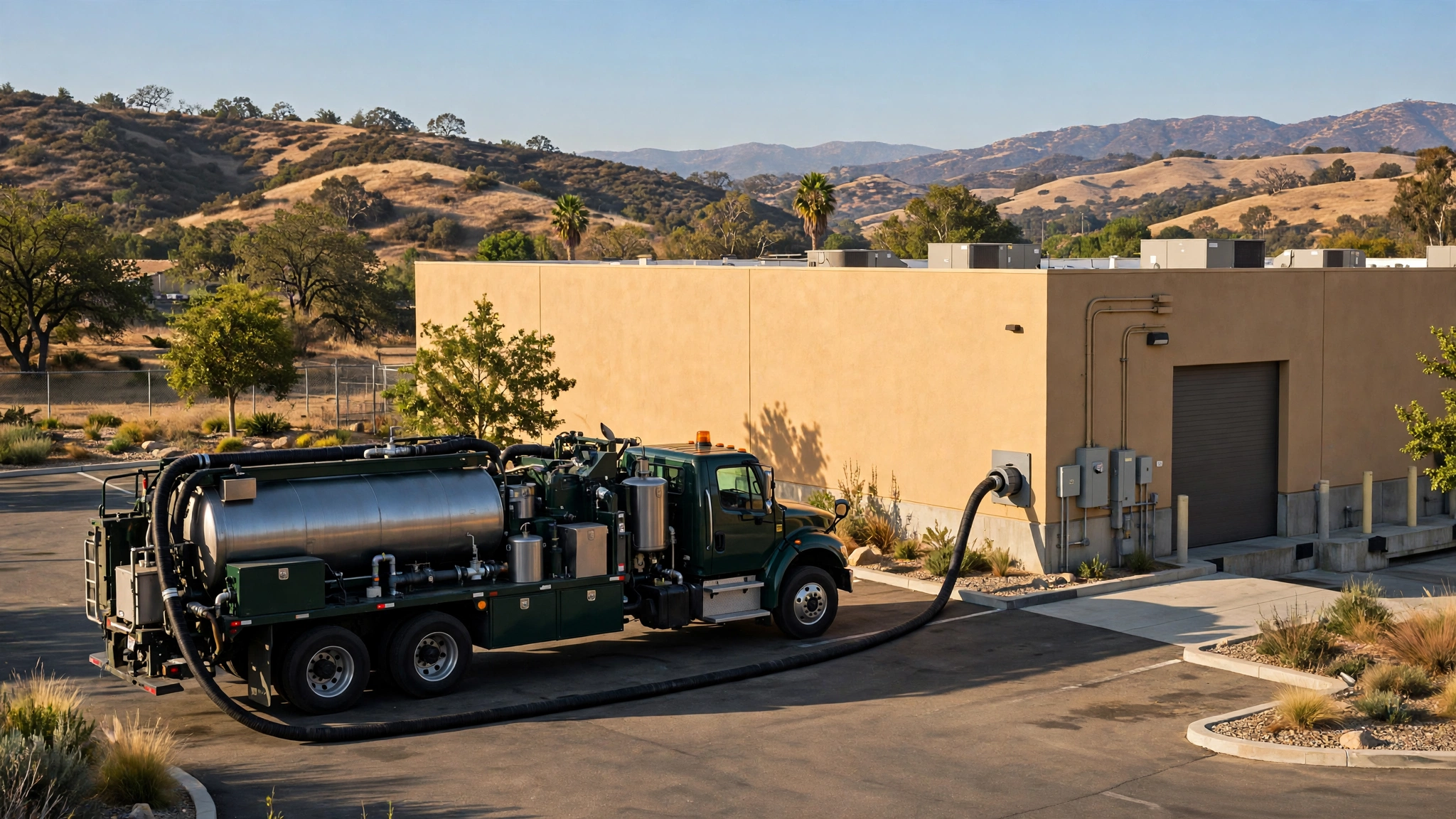 Commercial Septic
A commercial septic system is not a bigger version of a residential one. It serves more people, handles more water, fills faster, and fails in public. A restaurant backup during dinner service, an office restroom out of order on a workday, or a facility alarm during operating hours costs money from the first minute, and it costs reputation on top of that. Commercial pumping is planned around the business, not the other way around.
The difference is the schedule. A home is pumped every three to five years and the date is flexible. A business is pumped on a contract: a set interval, a set scope, and a crew that arrives when the business can afford to have them there. The work is documented, the waste is disposed of with certified reporting, and the business has records to show a landlord, an inspector or a health department reviewer.
Waste Cleanup Services, operating as Flex Sanitation, is a family owned and operated septic company based at 934 Warwick Ave in Thousand Oaks, serving Thousand Oaks, Newbury Park, Westlake Village, Agoura Hills and Moorpark. We are licensed, bonded and fully insured. This page explains how commercial septic differs from residential, which businesses we serve, how scheduled pumping plans work, and what commercial service costs.
How commercial septic differs from residential
The first difference is volume. A restaurant, an office or a facility can send many times more water through a system in a day than a house does, and the tank fills with sludge far faster. A pump-out interval that works for a home would leave a commercial tank overflowing. Commercial systems are pumped on a measured schedule based on actual use, not on a generic calendar.
The second difference is the system itself. Commercial properties often have larger tanks, multiple tanks, lift stations, pumps and alarms, and grease traps feeding the same system. The crew has to know the whole installation, not just the tank lid. The third difference is the stakes: a residential backup is a bad day, while a commercial backup is a closure, a health inspection and lost revenue, all at once.
The fourth difference is documentation. A homeowner keeps pump-out records for their own peace of mind. A business keeps them because someone else will ask for them: a landlord, a health department reviewer, an insurer, or a buyer doing due diligence on the property. Every commercial visit ends with certified reporting, so the record exists whether or not anyone asks for it that month.
Industries we serve
Restaurants and food service are the largest group, because kitchens produce grease as well as wastewater, and the trap and the tank have to be serviced together. Offices and professional buildings come next, with restroom-driven systems that fill steadily and need predictable scheduling. Warehouses, workshops and light industrial properties have their own patterns, often with wash-down water and intermittent heavy use.
We also serve multi-unit properties, including property managers and homeowners associations, where one system serves several households and no single resident owns the maintenance. Schools, care facilities, event venues and agricultural properties round out the list. Each has a different water pattern, and the service plan is built around that pattern rather than around a standard residential schedule.
What these businesses share is that septic is not their business, and it should not take their time. The property manager who has to explain a backup to tenants, the restaurant owner who loses a Friday night to a flooded kitchen, and the facility manager facing a health inspection all need the same thing: a system that works, a schedule that is kept, and a crew that answers the phone. A commercial plan is built to deliver exactly that, with no surprises in the middle of a service day.
Scheduled pumping plans
A scheduled plan starts with an assessment: tank size, system type, number of users, water use, and the history of pump-outs. From that, the crew sets an interval, often quarterly, twice a year or annually, depending on the volume. The plan is written down, the dates are set in advance, and the business knows when the truck is coming before the tank is anywhere near full.
The plan also covers the extras that a one-off visit misses. The baffles and filter are checked at every visit. The grease trap is cleaned on its own schedule where one exists. The alarm and pump are tested where the system has them. And the work is done after hours where the business needs it: a restaurant pumped after closing, an office pumped on a weekend, a facility pumped overnight. The goal is a system the business never has to think about, because the plan thinks about it.
Compliance and reporting
Commercial properties live under more scrutiny than homes. A landlord may require service records. A health department may ask for proof of disposal. A property sale or a lease renewal may need the system's history. Every commercial visit is documented with certified reporting: what was pumped, when, how much, where the waste went, and the condition of the tank and its components.
Permits follow the same county rules as residential work. New installs and major repairs need a permit from Ventura County Environmental Health for Thousand Oaks, Newbury Park and Moorpark, or from LA County Public Health for Westlake Village and Agoura Hills. Routine pumping needs no permit. Keep the service records with the property file: they are the proof that the system has been maintained, and they are what an inspector asks for first.
What commercial pumping costs
Commercial pumping is priced by tank size, volume and frequency, not by a flat residential rate. A larger tank takes longer to pump. A high-volume property needs more frequent visits. A scheduled contract is usually the most cost-effective option, because the crew knows the property, the access is planned, and the visits are routine rather than emergency call-outs.
Our published range for a standard residential pump-out is $485 to $780 for a tank from 1,000 gallons in Thousand Oaks. Commercial work is quoted separately, based on the system and the schedule, and the quote is given in writing with the tank size, the interval and the reporting included. A contract quote can be compared fairly only when those items are listed, so ask for them in writing before you sign.
Emergency response for businesses
Even a well-maintained commercial system can have an emergency: a sudden backup, a pump failure, an alarm that will not stop. Our dispatch runs 24 hours a day, seven days a week, and commercial emergencies go to the front of the queue. Call (805) 307-3409, describe the symptoms, and the dispatcher will confirm the next available crew and a time window.
While you wait, stop water use in the affected area, keep staff and customers away from any sewage, and do not open the tank. The emergency pump-out follows the same five steps as a routine pump-out: inspection and tank location, cover access and vacuum setup, complete sludge and liquid removal, tank cleaning and baffle inspection, and eco-friendly disposal with certified reporting. Once the backup is stopped, the technician explains the cause and the repair or schedule change that will keep it from happening again.
Setting up a commercial pumping plan
- Assess the system: tank size, users, water use and pump-out history
- Set the interval from measured use, not from a generic calendar
- Include baffle, filter and alarm checks at every visit
- Add grease trap cleaning to the same contract where one exists
- Schedule visits after hours or on weekends where the business needs it
- Keep every service record with certified reporting in the property file
What it costs
A standard septic pump-out in Thousand Oaks is $485–$780 for a tank from 1,000 gallons — upfront and flat-rate, with no hidden disposal or cover fees. The exact number depends on tank size, sludge level, lid depth and access.
- Pumping (standard tank, 1,000+ gal): $485–$780
- Inspection: priced by scope — see the inspection page
- Emergency / after-hours: factors on the cost guide
How a pump-out works, step by step
Every pump-out follows the same five steps — no shortcuts, no surprises. You see what we do, and you get a report that proves it.
On-site inspection & tank location
We find the tank, check the access, and look at the system before any work starts — lids, risers, baffles and the drain field.
Cover access & vacuum line setup
The tank is opened safely and the vacuum line is run from the truck. No mess in the yard, no damage to the landscaping.
Complete sludge & liquid removal
The truck removes the sludge, the scum and the liquid — the whole tank, both compartments, not just the top layer.
Tank cleaning & baffle inspection
The tank is washed down and the inlet and outlet baffles are checked. A broken baffle is the most common reason a field fails — we catch it here.
Eco-friendly disposal & certified reporting
Waste goes to a certified disposal facility, never dumped. You get a written report of what was pumped and the condition of the tank.
Tell us about your septic system
A few details is all it takes — what is happening, where you are, and anything you already know. We reply within one business day with next steps and a free estimate.
Prefer to read first? The cost guide breaks down every price factor, and the inspection page explains what a report covers.
Request a Free Estimate
Tell us about your septic system — we reply within one business day.