Leach Field Repair & Replacement
A soggy yard, sewage smells or drains that never quite clear often mean the leach field, not the tank. We diagnose the field properly before recommending repair or replacement. Call (805) 307-3409.
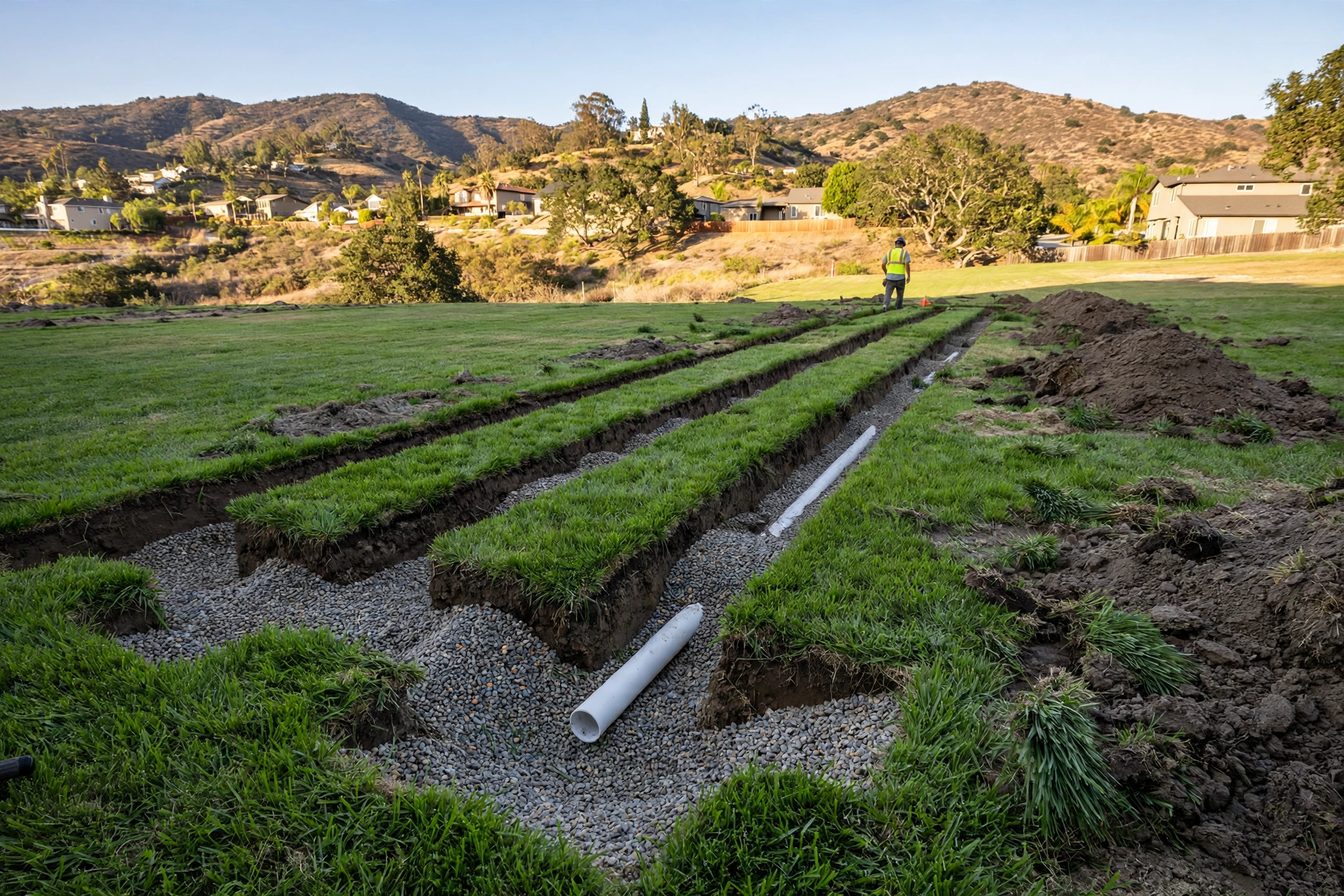 Leach Field
The leach field is the quiet half of a septic system and the expensive half when it fails. The tank is a box you can open, pump and repair. The field is a network of trenches buried in the yard, and when it stops absorbing water, the whole system stops working. Drains slow down, sewage surfaces in the lawn, and pumping the tank only buys a few weeks before the backup returns.
A failing field is not always a dead field. Some fields can be repaired in place. Some can be rested, jetted or extended. Some have to be replaced, either in a new location on the lot or as a redesigned system. The difference between those outcomes is a diagnosis: what the soil is doing, what the solids did to it, and how much of the field is still working. Guessing wrong in either direction costs thousands of dollars.
Waste Cleanup Services, operating as Flex Sanitation, is a family owned and operated septic company based at 934 Warwick Ave in Thousand Oaks, serving Thousand Oaks, Newbury Park, Westlake Village, Agoura Hills and Moorpark. We are licensed, bonded and fully insured. This page explains what a leach field does, how to tell when it is failing, why fields fail, and what the repair and replacement options actually involve.
What a leach field does
The leach field, also called a drain field, is where the treated liquid from the septic tank goes to finish its journey. After solids settle in the tank, the liquid flows through the outlet into a distribution box, which splits it evenly between several trenches. Each trench is filled with gravel and a perforated pipe, and the liquid seeps out of the pipe, filters down through the gravel, and soaks into the soil.
The soil is the real treatment plant. As the liquid moves through it, bacteria and natural filtration remove the remaining contaminants before the water reaches groundwater. That is why the field needs area: the soil can only absorb and treat so much water per square foot per day, and a field sized for the house and the soil type works quietly for decades. A field that is undersized, overloaded or clogged with solids cannot do that job, and the liquid has nowhere to go but up.
The field has no moving parts and no power supply. Its enemies are solids, water overload and physical damage. Solids come from a tank that is not pumped or a baffle that has failed. Overload comes from too much water too fast. Physical damage comes from driving over the field, building on it, or roots crushing the lines. All three are preventable, and all three are the story behind most field failures.
Signs your leach field is failing
The classic sign is a soggy patch of lawn over the field that stays wet long after rain, or grass that grows far greener and faster there than anywhere else in the yard. The grass is feeding on the wastewater that is surfacing instead of soaking down. A sewage smell outdoors, especially near the field area, is another clear sign, as is wastewater visibly pooling on the surface.
Inside the house, a failing field shows up as drains that slow down across the whole home, toilets that gurgle, and backups that return soon after the tank is pumped. That last pattern is the diagnostic clue: if pumping the tank fixes the problem for a few weeks and then it comes back, the tank was never the problem. The tank was empty and the house still could not drain, because the field will not take the water.
A field can also fail quietly, with no surface signs at all, until a heavy weekend of laundry or guests pushes it over the edge. That is why an inspection matters when symptoms appear. Walking the field, checking the distribution box and running a flow test will show whether the field is working, struggling or finished, and that answer decides everything that follows.
Why leach fields fail
The most common cause is a layer of biological material called biomat that forms at the soil interface in the trenches. A thin biomat is normal and even useful: it helps treat the liquid. But when solids escape the tank, or when the field is overloaded with water, the biomat grows thick and seals the soil. Water can no longer pass through, the trench fills, and the field backs up. This is a slow process that takes years, and it is the direct result of a tank that was not pumped or a baffle that failed.
Hydraulic overload is the second cause. A leaking toilet, a running fixture or a household that sends all its laundry through the system in one day can push more water into the field than the soil can absorb. Over weeks and months, the soil stays saturated, the bacteria that treat the wastewater die back, and the field loses capacity. The fix is partly behavioral and partly mechanical, and it starts with finding the leak or the habit that is flooding the field.
Physical damage is the third cause. Tree roots grow into the perforated pipes and block them. Vehicles compact the soil over the trenches and crush the lines. Construction or landscaping cuts through a lateral. And on some lots, the original field was simply too small for the house, or was built in soil that was never suitable. A field that was undersized from the start will fail early no matter how well it is maintained.
Diagnosing a leach field problem
Diagnosis starts with the tank. The technician pumps it, inspects the baffles and the filter, and measures the sludge. If the baffle is broken, solids have been entering the field, and that tells the story. If the tank is sound, the diagnosis moves to the distribution box: is it level, is it sending water to all the trenches, or is one trench taking everything while the others sit dry?
Then comes the flow test. Water is run through the system and the technician watches how the tank level and the field respond. A field that accepts the flow and drains back down is still working. A field that ponds up and stays up is not. A camera inspection of the laterals shows roots, crushed pipe and blockages that the surface cannot reveal, and test pits can show the condition of the soil and the biomat directly.
The diagnosis ends with a clear statement: which trenches are working, which are not, what caused the failure, and what the options are. That statement is the basis for the quote, and it is what separates a repair plan from a guess. Any company that recommends a full replacement without opening the tank, checking the distribution box and testing the flow has not diagnosed the field.
Repair options
Repair in place is the first option when part of the field still works. A distribution box that has settled can be re-leveled so every trench gets its share. A clogged lateral can be hydro-jetted to clear roots and solids. A crushed section of pipe can be excavated and replaced without touching the rest of the field. These are targeted repairs, and they work when the failure is local rather than total.
Resting a field is the second option, and it works when the field is overloaded but not destroyed. Water use is cut back, the tank is pumped, and one section of the field is taken out of service while the soil dries and the biomat breaks down. Resting takes weeks to months, and it only helps if the household can reduce its water use in the meantime. It is not a fix for a field that is sealed with solids.
Some companies sell chemical or biological treatments that promise to restore a field without digging. Be honest about their limits: a treatment can help a mildly clogged field, but no additive dissolves a thick biomat, repairs a crushed pipe or replaces lost soil capacity. If a treatment is offered, ask what it can and cannot do, and get the expectation in writing before you pay for it.
When replacement is the only answer
Replacement is the answer when the field is sealed, the soil is exhausted, or the damage is total. A field that has received solids for years, a field built in the wrong soil, or a field that has been crushed across its whole area cannot be repaired back to health. The honest recommendation in that case is a new field, and the honest conversation is about where it goes and what kind of system it is.
A new field is usually built in a replacement area on the lot, a second area set aside for exactly this purpose when the system was first designed. If no replacement area exists, the design may have to change: a different layout, an alternative treatment system, or a mound. That is a design and permit project, not a weekend job, and it goes through the county health department with a soil evaluation and a new design.
Replacement is expensive, and that is exactly why the diagnosis matters. A full replacement quoted for a field that only needed a distribution box re-leveled is a costly mistake. Get the diagnosis in writing, get a second opinion if the quote is a replacement, and make sure the replacement design is based on a current soil evaluation rather than on the old system's drawings.
What leach field work costs
Field work costs vary more than almost any other septic job, because the range runs from a single pipe repair to a complete replacement. A targeted repair, such as re-leveling a distribution box or replacing a section of lateral, is a modest job. A full field replacement is a major project. Published guides like Angi or This Old House put typical market ranges for conventional drain field replacement roughly at $3,600 to $12,500, with alternative systems roughly $10,000 to $20,000. Those are market ranges, not our prices.
Our published price is the pump-out range: $485 to $780 for a standard tank from 1,000 gallons in Thousand Oaks. The pump-out is usually the first step of a field diagnosis, because the tank has to be empty before the baffles and the flow can be checked. The field work itself is quoted in writing after the diagnosis, with the excavation, the materials, the design and the permit fees listed separately.
Permits are part of the cost for replacement work. A field repair may need a county permit depending on its scale, and a replacement always does. In Ventura County that is Ventura County Environmental Health; in Los Angeles County it is LA County Public Health. The permit and the inspection are not optional extras: they are what make the new field legal, and what a buyer will ask for when the home is sold.
Protecting a new or repaired leach field
The best protection is the pump-out schedule. Pump the tank every three to five years, and the solids never reach the field. That single habit is worth more than any treatment product, because the biomat that kills fields is fed by solids, and the pump-out is what keeps solids in the tank where they belong.
Protect the field surface too. Do not drive or park over it, do not build a patio, a shed or a driveway on it, and do not plant trees with aggressive roots near the trenches. Keep roof runoff and drainage water away from the field area, and fix leaking fixtures promptly: a toilet that runs day and night can flood a field over weeks. Spread laundry through the week instead of running every load in a single day.
Finally, keep records. Note the date of the repair or replacement, keep the design drawings and the permit, and record every pump-out. A field with a known history is easier to diagnose, easier to sell with, and easier to protect, because the next technician starts from facts instead of from scratch.
If you suspect a leach field problem
- Pump the tank first — if the backup returns in weeks, it is the field
- Note the signs: soggy lawn, odors, slow drains across the house
- Ask for a diagnosis: tank, distribution box, flow test and camera
- Get the findings in writing before any replacement is quoted
- Check which county permit applies: Ventura or LA County
- After repair or replacement, protect the field and pump on schedule
What it costs
A standard septic pump-out in Thousand Oaks is $485–$780 for a tank from 1,000 gallons — upfront and flat-rate, with no hidden disposal or cover fees. The exact number depends on tank size, sludge level, lid depth and access.
- Pumping (standard tank, 1,000+ gal): $485–$780
- Inspection: priced by scope — see the inspection page
- Emergency / after-hours: factors on the cost guide
How a pump-out works, step by step
Every pump-out follows the same five steps — no shortcuts, no surprises. You see what we do, and you get a report that proves it.
On-site inspection & tank location
We find the tank, check the access, and look at the system before any work starts — lids, risers, baffles and the drain field.
Cover access & vacuum line setup
The tank is opened safely and the vacuum line is run from the truck. No mess in the yard, no damage to the landscaping.
Complete sludge & liquid removal
The truck removes the sludge, the scum and the liquid — the whole tank, both compartments, not just the top layer.
Tank cleaning & baffle inspection
The tank is washed down and the inlet and outlet baffles are checked. A broken baffle is the most common reason a field fails — we catch it here.
Eco-friendly disposal & certified reporting
Waste goes to a certified disposal facility, never dumped. You get a written report of what was pumped and the condition of the tank.
Tell us about your septic system
A few details is all it takes — what is happening, where you are, and anything you already know. We reply within one business day with next steps and a free estimate.
Prefer to read first? The cost guide breaks down every price factor, and the inspection page explains what a report covers.
Request a Free Estimate
Tell us about your septic system — we reply within one business day.