How Often Should You Pump Your Septic Tank?
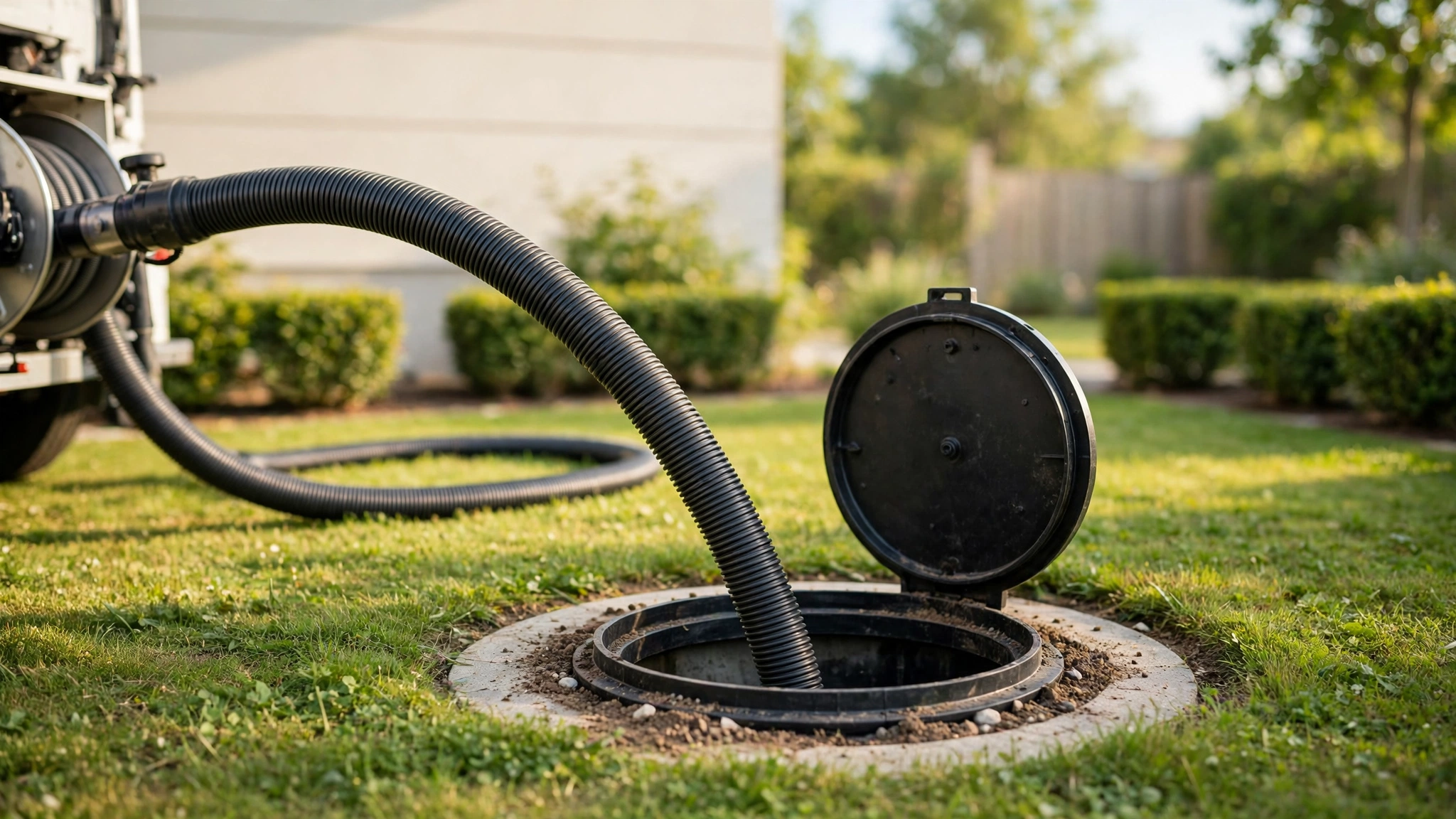
A septic tank does its work quietly, underground and out of sight, which is exactly why it is so easy to forget. Most homeowners in Thousand Oaks and the Conejo Valley only think about their tank when a drain slows down, a smell shows up, or water starts coming back where it should not. By then the job is no longer routine maintenance. It is an emergency, and it costs more, smells worse, and disrupts the household far more than a scheduled pump-out ever would.
The short answer to how often you should pump is every 3 to 5 years for most homes. That is the schedule most septic professionals and published guides work from, and it is the schedule we recommend across the Conejo Valley. But 3 to 5 years is a range, not a fixed date. A household of two with a 1,500-gallon tank can safely go longer than a household of six with a 1,000-gallon tank, and a home with a garbage disposal and heavy laundry loads will fill its tank faster than a home without them.
This guide explains where the 3 to 5 year rule comes from, the three things that change your schedule, the warning signs that mean you have waited too long, and a simple way to remember your next pump-out. Waste Cleanup Services, also known as Flex Sanitation, is a family owned and operated septic company based at 934 Warwick Ave in Thousand Oaks, serving the Conejo Valley since 2023. If you are unsure when your tank was last pumped, call (805) 307-3409 — our dispatch runs 24/7 and a technician can measure your sludge and scum levels and tell you where you stand.
The 3–5 year rule — and why it exists
Everything that goes down your drains ends up in the septic tank, and the tank separates it into three layers. The heavy solids sink to the bottom as sludge. The lighter material, fats, oils, and grease, floats to the top as scum. The liquid in the middle flows out to the leach field, where the soil filters and treats it. Pumping removes the sludge and scum layers before they grow thick enough to cause trouble.
The 3 to 5 year rule exists because sludge builds up slowly and steadily. In a standard residential tank of 1,000 to 1,500 gallons, it takes roughly that long for the sludge layer to reach the point where solids start escaping through the outlet baffle and into the leach field. Once solids reach the field, they clog the soil and the gravel trenches. A clogged field drains slowly, then stops draining, and a field that has failed cannot be fixed with a pump-out. It needs repair or replacement, which is one of the most expensive jobs in homeownership.
Pumping on schedule is therefore not about the tank itself. A concrete or fiberglass tank can last for decades when it is maintained. Pumping protects the leach field, and the leach field is the part of the system that is expensive and disruptive to replace. A pump-out every few years is a routine service visit. A failed drain field is excavation in your yard, permits, and a bill that typically runs into the thousands of dollars according to published guides like Angi or This Old House. The 3 to 5 year rule is the cheapest insurance a septic system has, and it assumes normal use: no garbage disposal running every day, no leaking toilets, and no one flushing wipes or grease down the drain.
What changes the schedule: household size
Household size is the single biggest factor in how fast a tank fills, because more people means more of everything: more showers, more laundry, more toilet flushes, and more solid waste. A tank does not care how big your house is. It cares how many people use the water every day, and that number is what sets your pumping interval more than anything else.
As a general guide, a household of one or two people with a standard 1,000 to 1,500 gallon tank can often stretch toward the five-year end of the range. A household of three or four people usually lands in the middle, around every 3 to 4 years. A household of five or more people, or a home with frequent overnight guests, should plan on the shorter end, around every 2 to 3 years. These are planning guides, not guarantees. The only way to know exactly where your tank stands is to open it and measure the sludge and scum layers, which is part of every pump-out and inspection we perform.
Household size changes over time, and your schedule should change with it. A couple whose children have moved out uses far less water than when the house was full, so their interval can stretch. A growing family, or a home that now hosts a home office, fills its tank faster. If your household has changed since your last pump-out, rethink the date rather than repeating the old one out of habit.
Guests matter too. A house that is quiet most of the year and full for a month in summer puts a short, heavy load on the system. That alone does not usually demand a new schedule, but if your tank was already near its limit, a busy holiday season is often when the first slow drain or gurgle appears.
- 1–2 people: often every 4–5 years with a standard tank
- 3–4 people: usually every 3–4 years
- 5 or more people: often every 2–3 years
- Frequent guests or a home office: move one step shorter
What changes the schedule: tank size
Tank size is the second factor, and it is straightforward: a bigger tank holds more sludge before it reaches the outlet, so it can go longer between pump-outs. Most standard residential tanks in Thousand Oaks and the Conejo Valley hold 1,000 to 1,500 gallons. A 1,500-gallon tank gives a household of four noticeably more time than a 1,000-gallon tank serving the same household, often an extra year or more.
But a bigger tank does not double your interval, and it does not forgive heavy use. A 1,500-gallon tank serving six people with a garbage disposal can still fill faster than a 1,000-gallon tank serving two careful people. Tank size and household size work together, and the combination is what sets the real schedule.
Older and smaller tanks deserve extra attention. Some older homes in the Conejo Valley have tanks smaller than 1,000 gallons, built when households used less water and the rules were different. If your home has a small tank, your interval is shorter, and you should confirm the size at your next service visit rather than assuming it is standard. A small tank that is pumped on a standard schedule is a tank that is being pumped late.
If you do not know your tank size, do not guess. The size is usually recorded on the permit or the installation record held by the county health department, and a technician can also estimate it from the tank dimensions during a pump-out. Once you know the size and the household count, the schedule mostly writes itself.
What changes the schedule: what goes down the drain
What goes down the drain changes how fast sludge builds up, and a few common habits can shorten your interval by a year or more. A garbage disposal is the biggest one. Every time it runs, it sends ground-up food into the tank, and food becomes sludge. A household that uses a disposal daily fills its tank noticeably faster than a household that scrapes plates into the trash. If you use a disposal, plan on the shorter end of your range.
Grease is the second habit to watch. Cooking oil and fat poured down the sink float to the top of the tank and add to the scum layer. Over time, grease also coats the inside of pipes and the outlet baffle. Let grease cool in a container and throw it in the trash instead. It is a small habit that makes a real difference to how long your tank lasts between pump-outs.
So-called flushable wipes are the third problem. They do not break down in a septic tank the way toilet paper does. They add to the sludge and snag on baffles and filters. Only toilet paper and human waste should be flushed. Everything else, wipes, paper towels, cotton swabs, feminine products, and dental floss, belongs in the trash.
Water use matters as much as what is in the water. A leaking toilet can send hundreds of gallons a day through the system, stirring up the tank and pushing solids toward the field. Spreading laundry across the week, fixing leaks quickly, and using water-efficient fixtures all help the tank settle properly between loads.
Signs you waited too long
A septic tank rarely fails without warning. It sends signals for weeks or months first, and the homeowners who catch them early usually get away with a routine pump-out. The homeowners who miss them end up calling for emergency service, and the repair that follows is almost always bigger than a pump-out would have been.
The earliest sign is usually slow drains throughout the house. One slow drain is a local clog. Every drain slowing down at once, sinks, showers, and toilets together, is a system problem, and a full tank is the most common cause. Gurgling sounds from drains or toilets are another early sign. Air trapped in the system bubbles back through the plumbing when the tank is full and the field is struggling to take more liquid.
Smells are the next stage. A sewage odor inside the house, near drains, or outside over the tank or the leach field means wastewater is not moving where it should. Standing water or soggy spots in the yard, especially over the leach field, mean effluent is surfacing instead of draining into the soil. Unusually green, lush grass over the field is the same problem in a prettier form: the grass is feeding on wastewater that should be underground.
The last sign is the one no one wants: sewage backing up into the house, usually through the lowest drain or toilet first. At that point the tank is full, the field is overloaded, or both, and the only right move is to stop using water, keep people and pets away from the backup, and call for emergency pumping. Our dispatch runs 24/7 at (805) 307-3409.
How to remember: a simple schedule
The hardest part of septic maintenance is not the pumping. It is remembering to do it. The tank is underground, the system works silently when it is healthy, and three years pass faster than anyone expects. The fix is to make the next date concrete the moment the last pump-out is finished.
Start by writing down the date of your last pump-out and the tank size, if you know it. Then pick your interval: household size first, tank size second, drain habits third. Write the next date on a calendar, set a phone reminder for a month before it, and keep the service receipt with your home records — a buyer, an inspector, or a county office may ask for that history one day.
If you do not know when your tank was last pumped, do not guess and do not wait. A technician can measure the sludge and scum levels in a single visit and tell you whether you have a year left or whether you are already overdue. That measurement is part of every pump-out and inspection we do, and it turns a guess into a date.
The simplest system of all is to let the schedule repeat itself. Book the next pump-out when the current one is done, and let the reminder do the remembering. A septic system that is pumped on time is a system that lasts. Call Waste Cleanup Services at (805) 307-3409 and we will put your next date on the calendar.
Get a free estimate
Reading is a good start — a visit is better. Tell us about your system and we will price the real scope, explain what the tank needs, and give you a fixed number. Free, no obligation.
Related service: Emergency Septic
Request a Free Estimate
Tell us about your septic system — we reply within one business day.